15 Chess Mistakes That Keep Players Below 1000 Rating (And How to Fix Them)
If you're struggling to break through the 1000-rating barrier, these are the 15 mistakes you need to eliminate first.

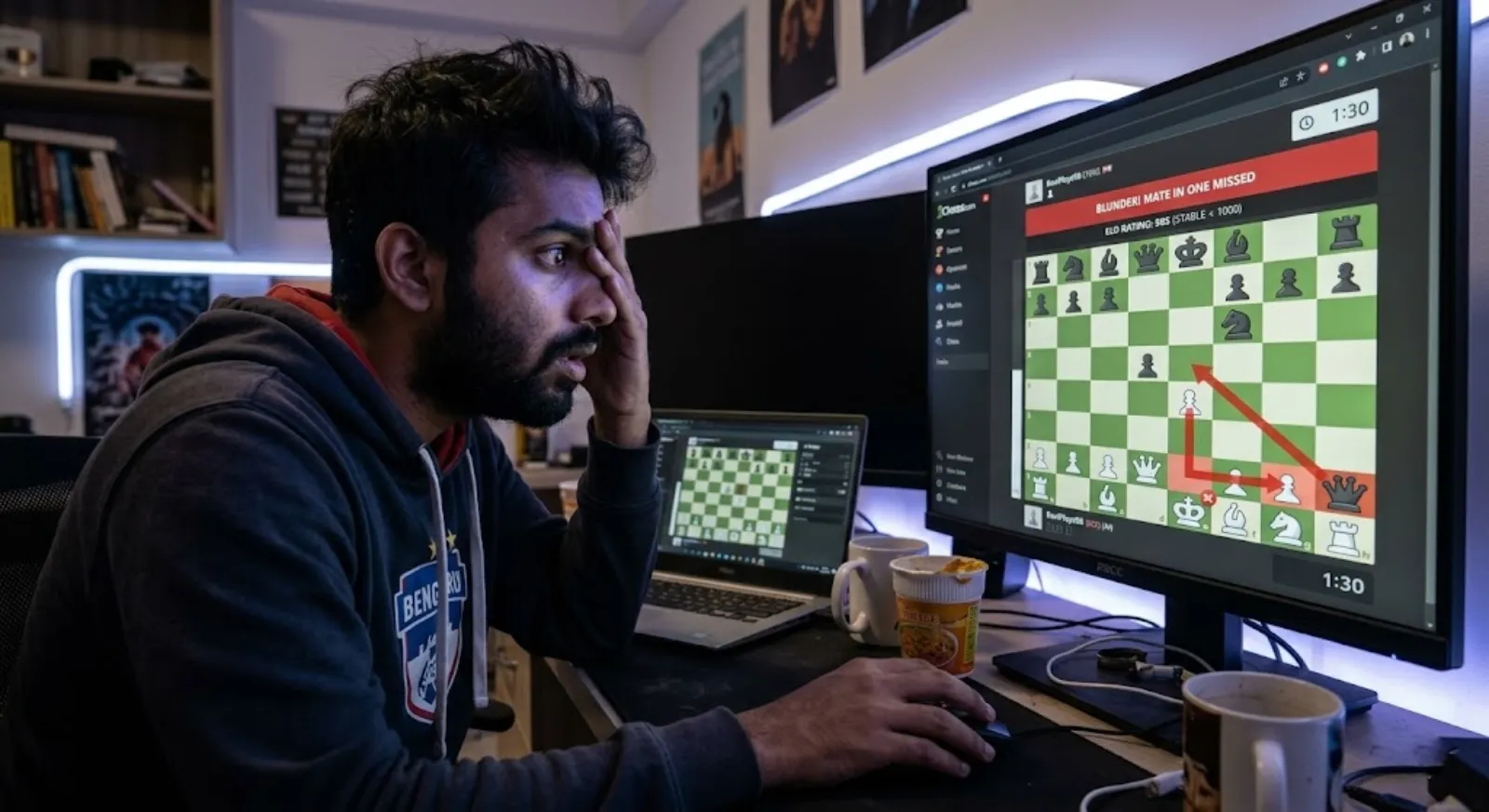
Every chess player remembers the frustration of being stuck below 1000 rating. You win a few games, lose a few games, and somehow end up right where you started. It can feel like you're studying openings, watching videos, and solving puzzles, yet your rating barely moves.
The truth is that most players under 1000 aren't losing because they don't know enough chess theory. They're losing because they repeatedly make the same avoidable mistakes.
After analyzing thousands of beginner games, a clear pattern emerges. Chess game players below 1000 often give away pieces, miss simple tactics, ignore king safety, and spend too much time learning things that don't matter yet.
1. Moving Too Fast
One of the biggest rating killers is playing moves instantly.
Many beginners see a move that looks reasonable and play it without checking for threats. A move that takes one second to play can cost an entire game.
How to Fix It
Before every move, ask yourself:
What is my opponent threatening?
Is any of my piece hanging?
Can my opponent check, capture, or attack something?
This simple habit alone can add hundreds of rating points over time.
2. Hanging Pieces for Free
A "hanging piece" is a piece that can be captured without compensation.
Beginners often focus so much on their own plans that they completely miss an undefended knight, bishop, or rook.
How to Fix It
Before clicking your move:
Scan every piece on the board.
Check which pieces are defended.
Look for enemy attacks.
Most games below 1000 are decided by a free piece giveaway.
3. Ignoring Basic Tactical Patterns
Many players study openings for hours but don't recognize forks, pins, and skewers.
A player who spots tactics consistently will beat a player who memorized 20 opening moves.
Essential Tactics to Learn
Forks
Pins
Skewers
Double attacks
Discovered attacks
Removing the defender
Tactical awareness is the fastest path to rating improvement.
4. Playing Too Many Openings
Beginners often switch openings every week.
One day it's the Sicilian Defense. The next day it's the King's Indian. Then they watch a video about the Scandinavian Defense and switch again.
How to Fix It
Choose:
One opening for White
One defense against e4
One defense against d4
Stick with them for at least 100 games.
Consistency beats variety.
5. Delaying Castling
Leaving your king in the center is an invitation for disaster.
Many under-1000 players spend several moves attacking while forgetting king safety.
Why It Matters
A king stuck in the center becomes vulnerable to:
Checks
Pins
Tactical combinations
Early attacks
Castle early whenever possible.
6. Attacking Without Development
Many beginners launch attacks before their pieces are ready.
They push pawns aggressively while their bishops and knights remain undeveloped.
Better Approach
Develop first:
Knights
Bishops
Castle
Connect rooks
Then start looking for attacks.
Strong positions create strong attacks.
7. Trading Without a Reason
Beginners often exchange pieces simply because they can.
Every trade changes the nature of the position.
Ask Yourself
Does this trade improve my position?
Am I helping my opponent?
Will this simplify into a winning endgame?
Meaningful trades lead to better results.
8. Ignoring Opponent Threats
A common beginner mindset is:
"I have an attack, so I'm going to continue attacking."
Meanwhile, the opponent is threatening checkmate.
Golden Rule
Every move should begin with:
"What does my opponent want?"
Many games are lost because players never ask this question.
9. Moving the Same Piece Repeatedly
During the opening, some players move the same knight three or four times while other pieces stay on their starting squares.
This wastes valuable tempo.
Better Strategy
Aim to develop all your pieces before making repeated maneuvers.
Every move should improve your position.
10. Chasing Pawns
Winning a pawn feels good.
Losing your position because of that pawn feels terrible.
Beginners often grab material without considering:
Development
King safety
Piece activity
A small material gain is rarely worth a damaged position.
11. Fear of Sacrifices
Many players assume every sacrifice is bad.
Strong players understand that material is only one part of chess.
Sometimes sacrificing a pawn or even a piece creates:
A winning attack
Better development
Long-term compensation
Learning when sacrifices work is an important milestone.
12. Not Solving Chess Puzzles
Reading about tactics is useful.
Solving tactics is transformative.
Most improving players spend time every day identifying patterns through puzzles.
Recommended Habit
Solve:
10 to 20 puzzles daily
Focus on accuracy
Review mistakes carefully
Consistency matters more than volume.
13. Playing Blitz All the Time
Fast games are fun.
They're also terrible teachers when used exclusively.
Blitz encourages:
Guessing
Moving instantly
Ignoring calculation
Better Balance
For every blitz session:
Play at least one rapid game
Analyze your mistakes afterward
Rapid chess builds stronger habits.
14. Never Reviewing Lost Games
Many players lose and immediately start another game.
This is like taking a test and never checking the answers.
Post-Game Review Checklist
Find:
First major mistake
Missed tactic
Better alternative move
Opening issue
Every loss contains a lesson.
15. Thinking Rating Improvement Comes From Openings Alone
Perhaps the most damaging misconception in beginner chess is believing that memorizing openings will solve everything.
The reality is simple:
A player who never hangs pieces and spots basic tactics will usually outperform a player who memorized 15 moves of theory.
Focus on:
Tactics
Calculation
King safety
Piece activity
The rating gains will follow naturally.
How to Break 1000 Rating Faster
If you're currently stuck below 1000, follow this simple weekly improvement plan:
Daily
Solve 15 tactical puzzles
Play 1 rapid game
Review every loss
Weekly
Study one tactical theme
Review 3 losing games deeply
Practice your chosen openings
Monthly
Track recurring mistakes
Focus on eliminating one weakness at a time
Most players don't need more chess knowledge. They need fewer mistakes. The difference between an 800-rated player and a 1200-rated player is often not brilliant strategy. It's simply avoiding the blunders that repeatedly throw away winning positions.
Eliminate the 15 mistakes above, and you'll likely find yourself climbing past 1000 sooner than you think.
Comments (0)
Be the first to comment.